 QUANTUM WAVEResearch workspace ↗
Make the work inspectable
A practical guide to the fixed-geometry hydrogen pilot and its research records
01 / Choose the question
Both pilot tasks study neutral singlet H₂ at a bond length of 1·4 bohr with nuclear repulsion included in the total energy PySCF computes RHF and full configuration interaction in STO-3G FermiNet represents a continuous-space neural trial wavefunction evaluated with variational Monte Carlo These are different approximations — the finite-basis FCI energy is not an exact continuous-space reference
02 / Execute the baseline
Unpack the kit and follow its README in a fresh Python environment The kit contains the PySCF baseline, a separate recomputation script, pinned CPU dependencies, tests and a FermiNet training template Run on your own hardware and retain the configuration, result, log and environment details
python baseline.py --out output/baseline
python verify_baseline.py \
  --config output/baseline/config.json \
  --result output/baseline/result.json \
  --out output/recomputed
Commands are executable code — preserve filenames and numerical notation exactly as provided in the kit
03 / Publish the evidence
Connect your OKX or another compatible EVM wallet and sign the login message Open a task and start a submission Upload configuration, result and log artifacts — neural submissions also require a checkpoint Enter the actual engine version, seed, total energy, sample count and sampling uncertainty Explain convergence, hardware, environment and limitations before publishing
Each file must be no larger than 32 MB with at most 12 files per record and a 256 MB daily allowance
Draft artifacts are private to their author and project administrators
Publishing makes ready artifacts public and freezes the record
The browser verifies the stored SHA256 checksum before downloading a file
04 / Independently evaluate
An authorized reviewer retrieves the published evidence and performs their own evaluation The submitter and task owner cannot review their own work Upload the evaluation report and publish the method, actual outcome and limitations For neural models use a fixed checkpoint, a distinct seed, newly initialized walkers and sufficient burn-in Assess autocorrelation and uncertainty from separate stationary evaluation samples — training logs are not an independent evaluation
Reviewer authorization is managed by the project administrator
Different wallet addresses do not establish independent people or scientific expertise
A published assessment is attributed evidence under the stated policy and not an automated guarantee
What has actually run
A local PySCF RHF and STO-3G FCI calculation has completed with converged results A separate local recomputation matched the FCI energy within the configured tolerance The original artifacts are included under local-reference in the kit Both runs used the same machine and software — independent scientific validation remains pending
A 1000-step FermiNet GPU engineering pilot and a same-environment repeat have completed on an RTX 4090 The two runs agree within the internal numerical comparison tolerance Training energies are not independent fixed-model estimates — fresh-chain evaluation and independent scientific review remain pending A dedicated GPU worker streams live training diagnostics Open compute scheduling, token rewards and chain settlement are not connected The website never executes uploaded code or deserializes model checkpoints
Neural training evidence
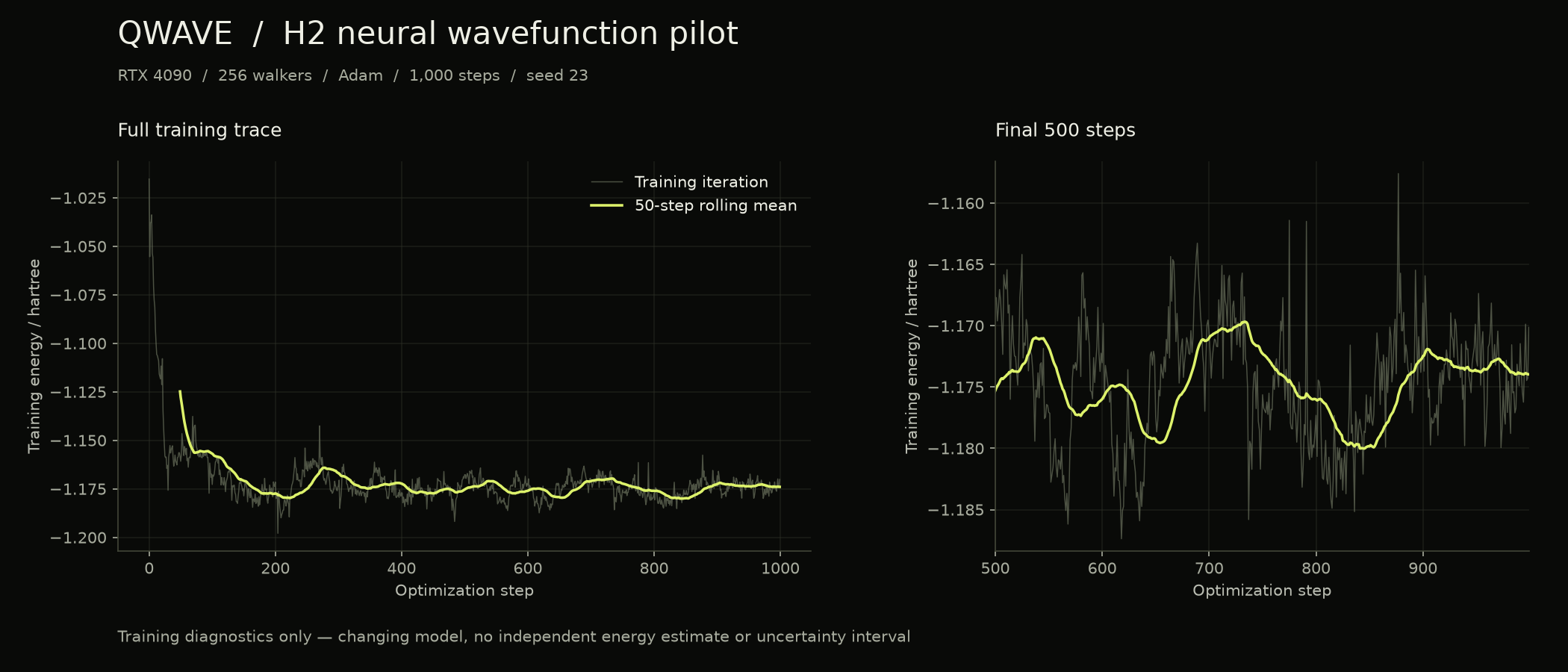
The completed pilot uses 256 walkers, four determinants and Adam optimization with 64-bit arithmetic The archive includes the actual model, configuration, logs, dependency lock and internal repeatability report
Research tools
Upstream tools are research dependencies and references — no partnership or endorsement is implied